
Peace, Sound and the Resonance of History
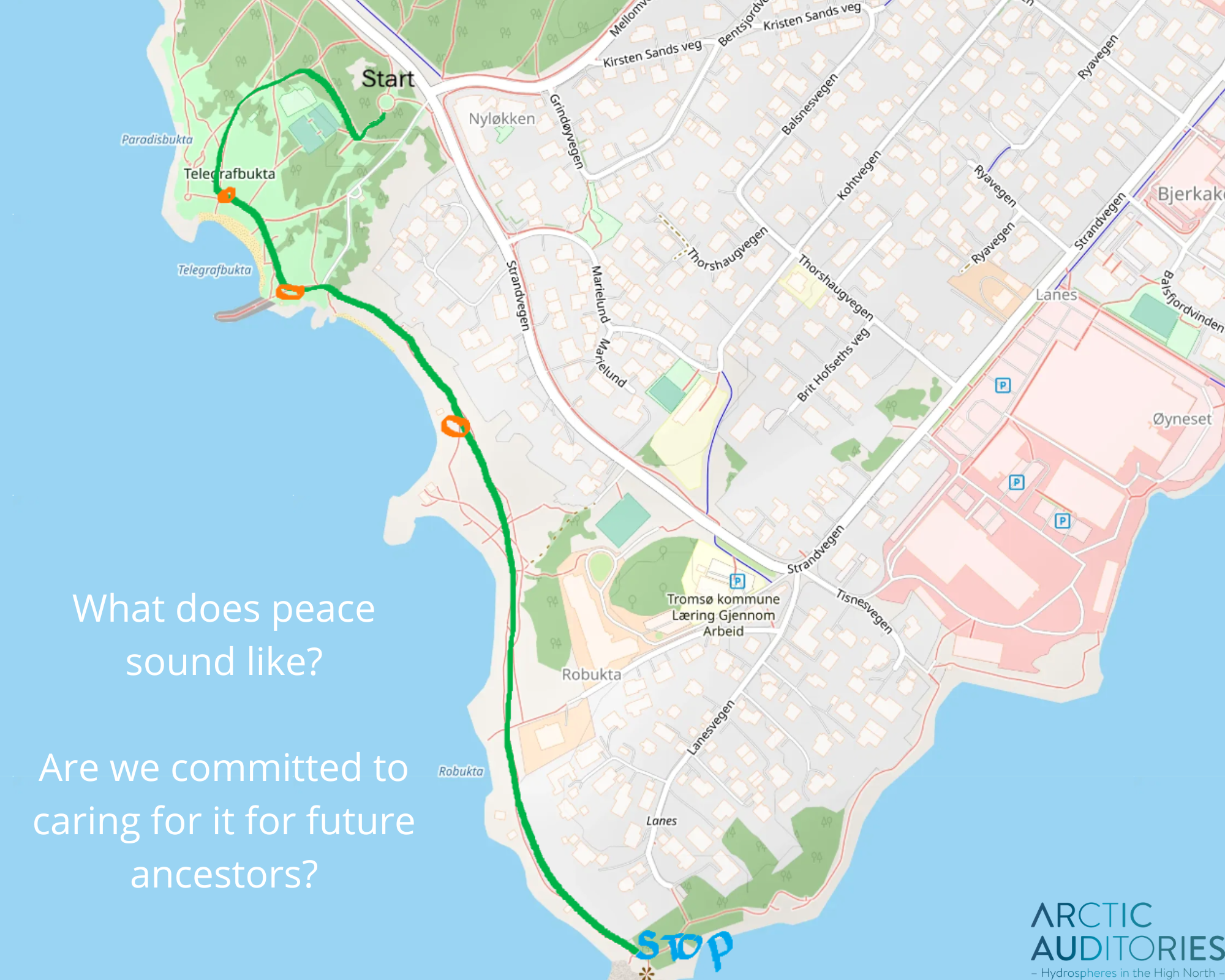
A Collaborative Walk from Tromsø’s Telegrafbukta to Sydspissen
Keywords:
peacebuilding, soundscapes, haptic geographies, heritage, future ancestryAbstract
An itinerary is a dynamic spatial practice that connects places in sequence. In everyday mobilities, we follow familiar routes almost automatically, often losing awareness of our surroundings as movement becomes routine. In unfamiliar settings, we may explore more actively, but without the knowledge or context needed to fully understand what we encounter.
Drawing on the pragmatics of communication and environmental humanities, this short walk along Tromsøya’s southern shoreline is designed to encourage deeper engagement with place, grounded in local awareness, historical understanding and sensory experience. Meaning emerges through interaction with contextual cues: the spatial arrangement and built landscape of the area, multimodal signage, and the sounds and silences of past and present. Participants’ contributions add further layers of awareness. In this way, itineraries can function as collaborative practices of situated meaning-making.
Learning to attend to the intricacies of place within our mobility practices may help foster a more reflective, peaceful and ethical attitude towards people, other living beings and the natural environment. This transformative potential affects both those who experience such walks directly and in situ, and those who later encounter these places from elsewhere and at different moments through forms of storytelling capable of transcending mainstream exclusionary imaginaries.
References
Barron, E. S., & Losleben, K. (2025). Emplacing watery encounters: Listening, care, and embodied knowledge in places of climate change. Progress in Environmental Geography, 4(2), 190–207.
Carlyle, A., Sweers, B., Barron, E. S., Losleben, K., & Mikalsen, P. R. (Eds.). (2024). Soundwalking & soundsitting: A manual for conductors. https://hdl.handle.net/11250/5509992
Guttorm, H. (2021). Becoming earth: Rethinking and (re-)connecting with the earth, Sámi lands, and relations. In R.-H. Andersson, B. Cothran, & S. Kekki (Eds.), Bridging cultural concepts of nature: Indigenous people and protected spaces of nature (pp. 229–258). Helsinki University Press. https://doi.org/10.33134/AHEAD-1-8
Kanngieser, A. M. (2022). Sonic colonialities: Listening, dispossession, and the (re)making of Anglo-European nature. Transactions of the Institute of British Geographers, 48(4), 671–702.
Leddy, S. (2025). Entangling sensing: Arts-based methods for teaching the environmental humanities and critical posthumanities. Lagoonscapes, 5(2), 311. https://doi.org/10.30687/LGSP/2785-2709/2025/02/002
Mieli, M., Zillinger, M., & Nilsson, J.-H. (2024). Phygital time geography, or: What about technology in tourists’ space-time behaviour? Tourism Geographies, 26(3), 389–406. https://doi.org/10.1080/14616688.2024.2318722
Oceanwide Expeditions. (n.d.). The loss of the airship Italia: The final curtain call of polar airship exploration. https://oceanwide-expeditions.com/blog/the-loss-of-the-airship-italia-the-final-curtain-call-of-polar-airship-exploration
Paganoni, M. C. (2023). The words and routes of peace-sensitive tourism. Poli-Femo, 26, 81–94.
Reitan, J. (2014). The Nazi camps in the Norwegian historical culture. In H. Bjerg, C. Lenz, & E. Thorstensen (Eds.), Historicizing the uses of the past: Scandinavian perspectives on history culture, historical consciousness and didactics of history related to World War II (pp. 57–76). transcript Verlag. https://doi.org/10.1515/transcript.9783839413258.57
Paterson, M. (2009). Haptic geographies: Ethnography, haptic knowledges and sensuous dispositions. Progress in Human Geography, 33(6), 766–788.
Published
Issue
Section
License
Copyright (c) 2026 Maria Cristina Paganoni, Paula Ryggvik Mikalsen

This work is licensed under a Creative Commons Attribution 4.0 International License.