Underdåniga herdar hos Sahlstedt, Wrangel och Hesselius
DOI:
https://doi.org/10.7557/4.8408Keywords:
herdespel, tragedi, pastoral, Abraham Magni Sahlstedt, Erik Wrangel, Andreas Hesselius Americanus, förväntningshorisontAbstract
The pastoral play Melicerta (1750) by Swedish author Abraham Magni Sahlstedt has been described as an “anti-pastoral” due to the characters’ behaviour: instead of fighting for their love, they willingly sacrifice it when an authority figure suggests that it would be sensible. This article aims to contextualise Melicerta by comparing it to two little-known tragedies from approximately the same period: Erik Wrangel’s Torilla (1738) and Andreas Hesselius Americanus’ Erick Den Nionde Eller Helige (1740). Both of the tragedies depict shepherds who display similar characteristics to Sahlstedt’s – obedience, humility and morality. I argue that these three plays hint at a forgotten horizon of expectation concerning the shepherd in Swedish literature in the mid-1700s. Furthermore, I suggest that this concept of the shepherd, far removed from the galanterie of early modern French pastoral, had a wider significance for pastoral poetry in Sahlstedt’s time, finding parallels in poems by Hedvig Charlotta Nordenflycht.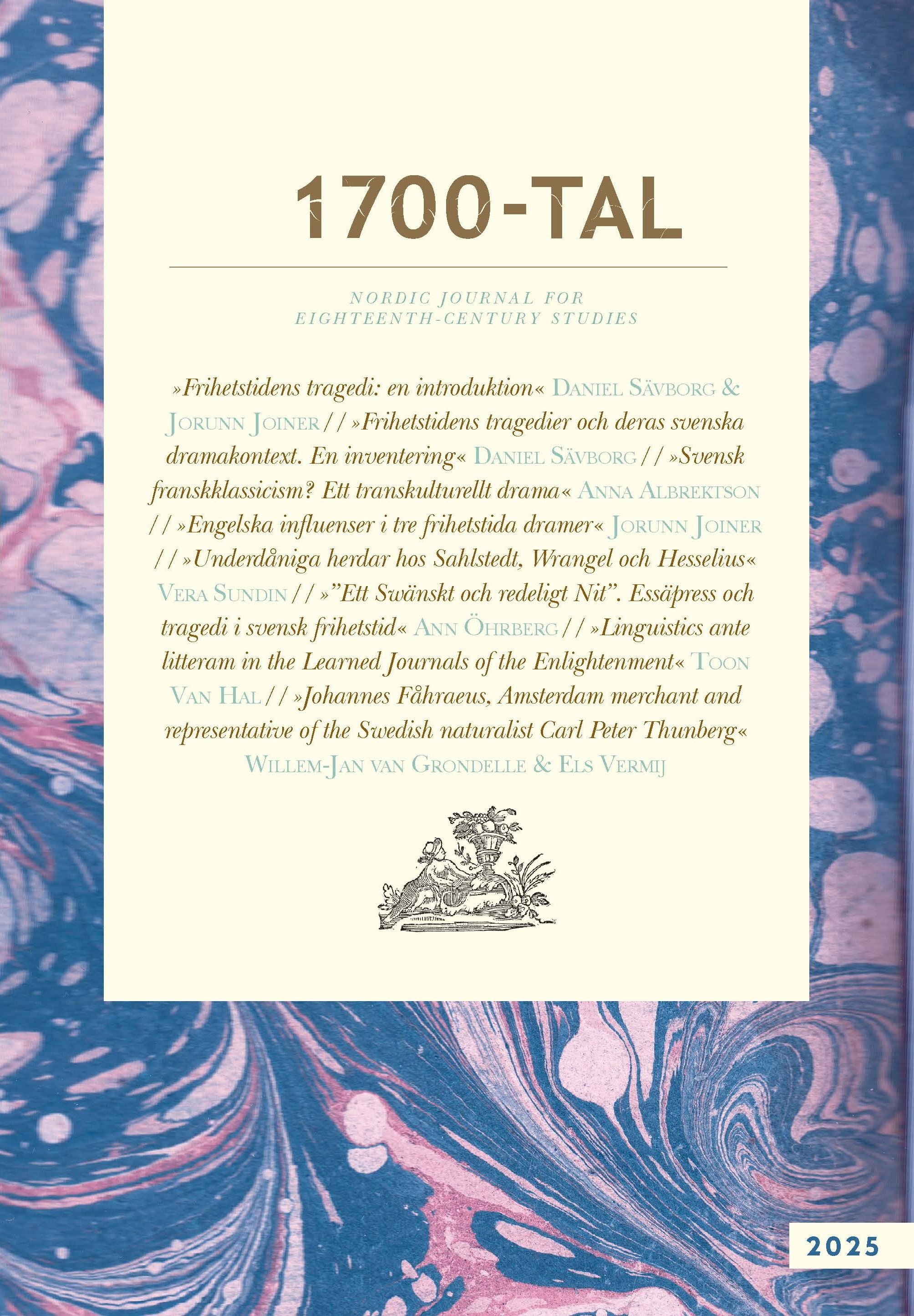
Downloads
Published
2025-12-31
Issue
Section
Peer-reviewed articles
License
Copyright (c) 2026 Vera Sundin

This work is licensed under a Creative Commons Attribution 4.0 International License.
How to Cite
Sundin, V. (2025). Underdåniga herdar hos Sahlstedt, Wrangel och Hesselius. 1700-Tal: Nordic Journal for Eighteenth-Century Studies, 22, 86–101. https://doi.org/10.7557/4.8408